
Why Rigid Track Saw Squares Prevent Cutting Vibrations and Error
In the world of precision woodworking, the difference between a project that assembles seamlessly and one that requires hours of sanding lies in the stability of your guide system. For professionals and enthusiasts alike, "chatter"—the micro-vibrations of a saw blade—and deflection are the primary enemies of a clean edge. Understanding the physics behind a rigid track saw square is essential for anyone looking to elevate their craft.
Table of Contents
- The Physics of Rigidity: Why Thickness Matters
- Eliminating Chatter and Deflection
- The SpeTool Advantage: Extra-Large Stability
- Compatibility and Workflow Efficiency
- Conclusion
The Physics of Rigidity: Why Thickness Matters
When using a track saw, the guide rail acts as the straight-edge reference. However, if the connection between the rail and the workpiece isn't perfectly perpendicular or stable, the force of the saw motor can cause the rail to shift slightly. This is where a track saw square guide becomes indispensable.
A thinner, flimsy square lacks the mass and structural integrity to resist the lateral forces generated during a cut. According to principles of vibration control, a more massive and rigid body has a higher damping capacity. A rigid track saw square serves as an anchor, ensuring that the rail cannot pivot or flex under the pressure of the saw's plunge or forward motion.
Eliminating Chatter and Deflection
Many woodworkers researching a spetool track saw square review cite "deflection" as their main concern with cheaper alternatives. Deflection occurs when the square's body bends under clamping pressure or tool load. This results in a cut that is slightly out of square, even if the tool originally read 90 degrees.
By utilizing an extra-thick design, a high-quality track saw square distributes clamping forces across a larger surface area. This prevents the "spring-back" effect and ensures that once the rail is set, it stays set. This is particularly vital when working with dense hardwoods or thick sheet goods where motor resistance is at its peak.
The SpeTool Advantage: Extra-Large Stability
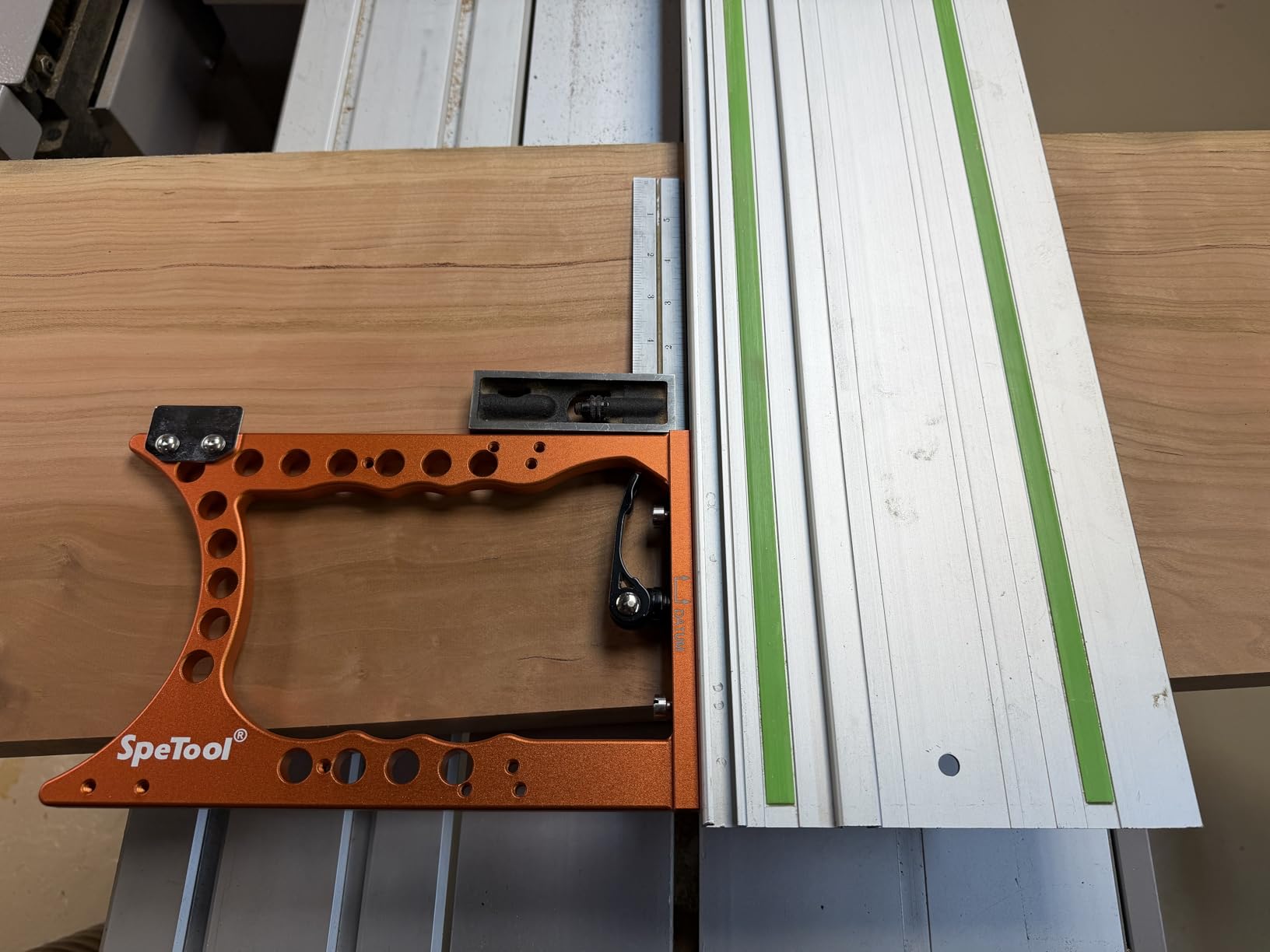
For those demanding the highest level of accuracy, the SpeTool Precision 90° Track Saw Square is engineered to solve these specific stability issues. Unlike standard squares, it features an extra-large and thicker design that provides enhanced rigidity and a more secure hold for flawless cuts.
Key highlights of this tool include:
- ±0.01° Ultra-Precision: Achieve perfect 90° cuts every time with a guaranteed accuracy level engineered for high-precision joinery.
- Superior Stability: The robust construction significantly reduces vibration and prevents the rail from shifting during heavy-duty operations.
- Quick & Effortless Operation: A smooth, one-handed quick-lock mechanism allows for instant setup, which is a major point of praise in any spetool track saw square review.
- Scratch-Free Protection: The clamping system securely grips your rail without leaving marks or dents, preserving your expensive guide rails.
Note: The minimum workpiece thickness for this square is 9MM.
Compatibility and Workflow Efficiency
One of the most frustrating aspects of shop upgrades is tool incompatibility. A versatile track saw square guide should work with the tools you already own. The SpeTool design is universally compatible with major brands including Festool, Makita, Milwaukee, Powertec, and Wen.
By integrating a track saw square into your workflow, you eliminate the need for measuring and marking multiple points on a board. You simply slide the square onto the track, lock it against your workpiece edge, and cut. This repeatable accuracy is what separates hobbyist results from professional-grade furniture.
Conclusion
Investing in a rigid track saw square is not just about getting a 90-degree angle; it's about controlling the variables of vibration and deflection. Tools like the SpeTool Precision Square provide the mass and locking power necessary to ensure that your first cut is as accurate as your last. For more high-performance woodworking accessories, explore the full range of SpeTool CNC and woodworking tools.