
Track Saw Square vs. Traditional Framing Square: Which is Faster?
When it comes to breaking down sheet goods like plywood or MDF, accuracy and speed are the two most critical factors for professional contractors and serious DIYers. For decades, the traditional framing square was the go-to tool for layout. However, the rise of the track saw has introduced a more specialized companion: the track saw square guide. But does this modern tool actually save time, or is it just another gadget in the workshop?
Table of Contents
- The Traditional Framing Square Method
- The Track Saw Square Guide Method
- Speed vs. Accuracy: The Side-by-Side Comparison
- Why the SpeTool Track Saw Square Wins
- Conclusion: Which Should You Choose?
The Traditional Framing Square Method
The traditional framing square (or steel square) is a versatile tool used for everything from stair layout to roof framing. When squaring sheet goods, you typically mark your measurement on both sides of the sheet, draw a line with the square, and then attempt to align your circular saw or track saw guide rail to that line manually.
While reliable, this process involves several steps: measuring twice, marking once, and then performing a visual alignment. Each step introduces a small margin for error. If your mark is off by even a millimeter, a 4-foot crosscut can result in a piece that is noticeably out of square.
The Track Saw Square Guide Method
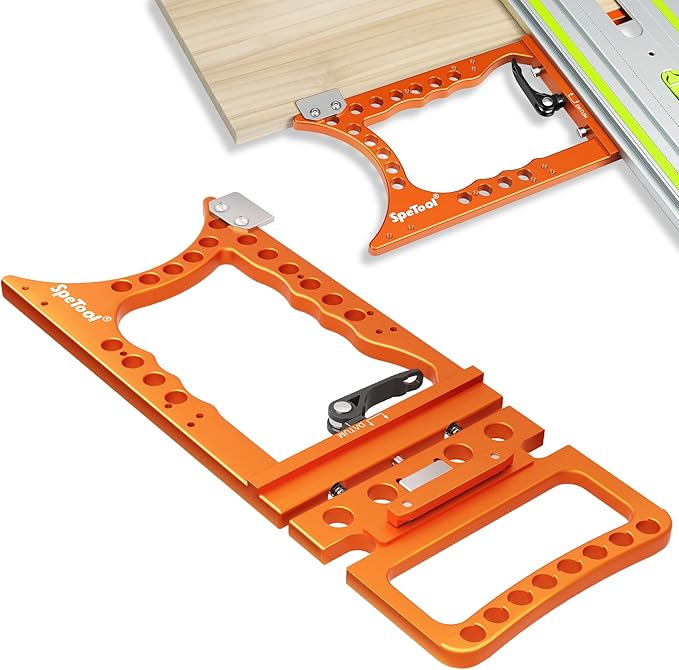
A track saw square is designed to slide directly onto your existing guide rail. Once attached, it creates a fixed 90-degree reference point against the edge of your workpiece. There is no need to draw a line across the entire sheet; you simply hook the square against the edge, and your rail is automatically positioned perfectly perpendicular.
Using a guide rail square eliminates the 'visual alignment' step entirely. It turns your track saw into a portable panel saw, allowing for rapid, repeatable cuts without the constant need for a tape measure and pencil.
Speed vs. Accuracy: The Side-by-Side Comparison
1. Setup Time
A framing square requires you to layout the cut first. With a track saw square guide, setup is near-instant. You slide the square onto the rail, lock it, and you are ready to cut. For multiple identical cuts, the track saw square is significantly faster.
2. Accuracy
Framing squares can vary in quality and can easily be knocked out of square if dropped. In contrast, high-end track saw squares are CNC-machined from solid aluminum. For example, the SpeTool 90-degree precision track saw square offers a guaranteed accuracy of ±0.01°, a level of precision that is nearly impossible to achieve consistently with a manual layout.
Why the SpeTool Track Saw Square Wins
If you are looking to upgrade your workflow, the SpeTool model is engineered specifically to solve the common frustrations woodworkers face with traditional layout tools. It offers several unique advantages:
- Ultra-Precision: Achieves perfect 90° cuts every time with ±0.01° accuracy, locking securely across the entire contact surface.
- Quick & Effortless Operation: Features a smooth, one-handed quick-lock mechanism for instant setup and release, vastly improving work efficiency.
- Superior Stability: The extra-large and thicker design provides enhanced rigidity and reduced vibration for flawless cuts.
- Scratch-Free & Rail-Protect: The clamping system securely grips your rail without leaving marks or dents, protecting your expensive guide rails.
- Wide Compatibility: It is universally compatible with Festool, Makita, Milwaukee, Powertec, and Wen tracks.
Note: The minimum workpiece thickness for this tool is 9MM.
Conclusion: Which Should You Choose?
If you only occasionally cut plywood, a framing square might suffice. However, for contractors and DIYers who value their time and demand perfection, the track saw square is the clear winner. It reduces a multi-step layout process into a single, reliable motion, ensuring that your projects fit together perfectly the first time. For more precision woodworking tools, visit SpeTool.