
Metal vs. Plastic Drill Guides: Why Your Precision Projects Are Failing
For DIY enthusiasts and professional woodworkers alike, the pursuit of a perfectly vertical or precisely angled hole is a constant challenge. You buy a portable drill guide for hand drill hoping for drill-press accuracy, only to find your bit 'wandering' or the guide itself flexing under pressure. Often, the culprit isn't your technique—it’s the material of the tool itself. In the battle of metal vs. plastic construction, the winner determines whether your project is a masterpiece or a piece of scrap.
The Radial Runout Reality: Why Plastic Flexes
The most critical metric in precision drilling is radial runout—the deviation from the intended axis of rotation. A high-quality metal drill guide is engineered to minimize this. When using a plastic housing, the heat generated by the friction of the drill bit can cause the material to soften or expand. This leads to a 'walking' bit, where the hole becomes slightly elliptical rather than perfectly round.
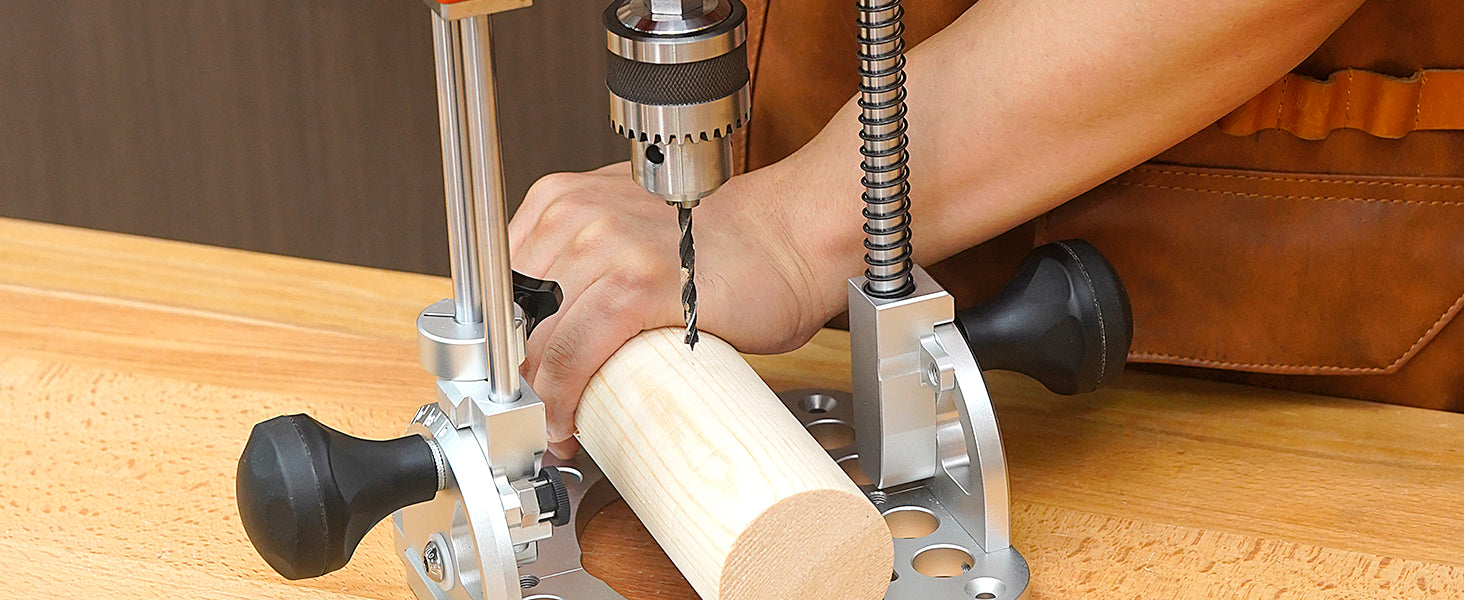
High-end options, like the SpeTool Portable Drill Guide, utilize an all-metal heavy-duty drill chuck that achieves an average radial runout of 0.004 inch. This level of millimetre-level precision is virtually impossible to maintain in plastic models that rely on friction-fit bushings.
Smoothness and Stability: The Plunge Action
A plunge drill guide must operate smoothly to ensure consistent depth and verticality. Plastic guides often suffer from 'stiction'—a jerky motion caused by plastic-on-metal friction. To combat this, precision metal guides incorporate liner ball bearings. This design reduces friction to the point where the guide operates in one smooth motion without the need for constant lubrication.
The Advantage of Weight
Weight is often equated with quality in the tool world, and for good reason. A lightweight plastic mini drill guide might be easy to carry, but it lacks the mass to dampen vibrations from a high-torque electric drill. An all-aluminum base, weighing in at over 8 lbs like the SpeTool model, provides a rock-solid foundation that resists the impact force of the drill, preventing damage to the workpiece.
Adjustability and the Diagonal Drill Guide Challenge
When you need to drill at an angle, the drill guide angle mechanism is put under immense stress. Plastic teeth and locking knobs are prone to stripping or slipping mid-drill. For a reliable diagonal drill guide, you need a system that offers secure locks.
- 0-60° Flexibility: Modern metal guides allow for infinite adjustments within this range.
- Positive Stops: Look for double-locking mechanisms that click in every 7.5° to ensure the angle doesn't drift during high-pressure operations.
- Stability Poles: While most guides use two poles, a three-pole system offers superior lateral stability.
Key Features of a Professional Metal Guide
If you are tired of 'disposable' tools, the SpeTool Professional Drill Guide offers a permanent solution to handheld inaccuracies:
- 0.004 INCH PRECISION: All-metal construction ensures the accuracy and control of a drill press in a portable format.
- Smooth Operation: Special liner ball bearings eliminate the need for lubrication and provide a catch-free plunge.
- Maximum Stability: Features three guide poles and an 8.36lb hard-anodized aluminum base.
- Versatility: Includes a built-in V-block for cylindrical workpieces (like pipes or dowels) and dual removable center pins for quick alignment.
Conclusion: Investing in Longevity
While plastic guides are tempting for their low entry price, they often become a 'disposable' purchase after a few projects. For those who value precision and longevity, an all-metal portable drill guide for hand drill is an essential investment. By choosing tools with low radial runout and robust locking mechanisms, you ensure that your precision projects never fail due to equipment flex.
For more information on precision woodworking standards, visit Wikipedia's Drill Press Overview or explore our full range of woodworking accessories.