
Stop the Bow: 5 Proven Ways to Prevent Panel Buckling During Glue Up
Every woodworker knows the sinking feeling of checking a freshly glued-up panel only to find a massive bow in the center. Whether you are building a dining table or a custom countertop, ensuring your boards stay perfectly flat is the difference between a professional finish and a piece that wobbles. In this guide, we will explore why panels buckle and the 5 best strategies to prevent panel buckling during glue up.
Table of Contents
- 1. Alternating Grain Direction
- 2. Managing Clamping Pressure
- 3. Using Cauls and Dominos
- 4. Alternating Clamp Placement
- 5. The Ultimate Solution: 4-Way Panel Clamps
1. Alternating Grain Direction
Wood is a living material that expands and contracts. When edge-gluing boards, one of the most effective ways to counteract natural movement is to alternate the direction of the end grain rings (pith side up, pith side down). This doesn't stop movement, but it helps ensure that the boards pull against each other rather than bowing in one single direction. For more on the science of wood movement, visit Wikipedia's guide on wood warping.
2. Managing Clamping Pressure
Too much pressure can be just as bad as too little. When you crank down on standard bar clamps, the force is applied to the edges. If the boards are even slightly misaligned, that force translates into vertical movement, causing the center of the panel to pop upward. Learning to apply balanced pressure is key to preventing buckling.
3. Using Cauls and Dominos
Traditional woodworkers often use "cauls"—clamped boards running perpendicular to the panel—to keep things flat. While effective, they are cumbersome and take up significant space in the shop. Similarly, using biscuits or a Festool Domino can help alignment, but they don't provide the vertical pressure needed to keep a wide panel flat during the entire drying process.
4. Alternating Clamp Placement
A common mistake is placing all clamps on the bottom or all on the top. This creates an uneven force vector. At a minimum, you should place one clamp below the panel, the next above, and so on. However, even with this method, you are fighting physics. This is where specialized tools like the spetool panel clamp become game-changers.
5. The Ultimate Solution: 4-Way Panel Clamps
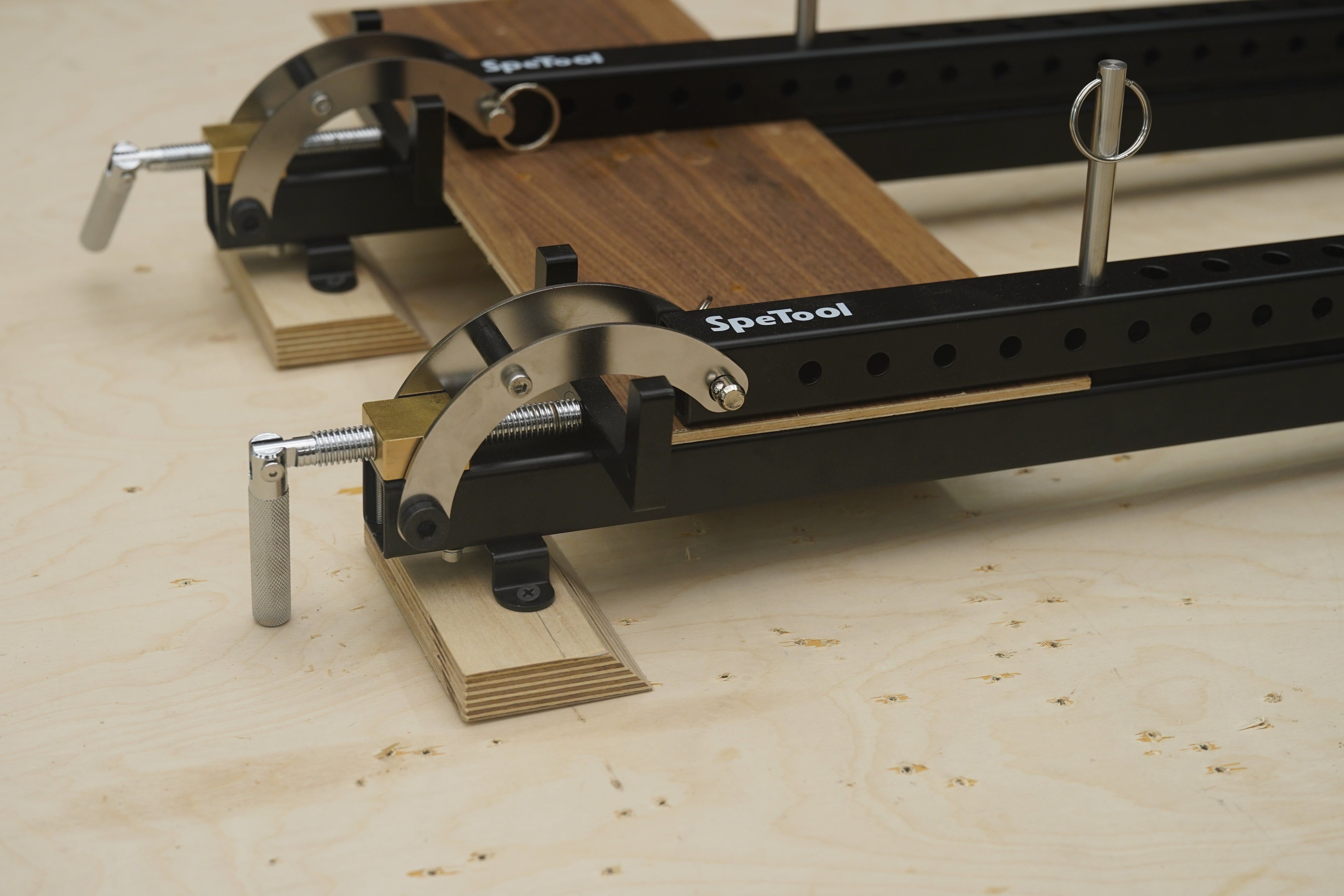
If you want to eliminate the guesswork and ensure a flat surface every single time, you need a system that applies pressure from all four sides simultaneously. The SPEtool 24-inch 4-Way Panel Clamp is designed specifically to solve the buckling problem.
Why the 4-Way System Works
Unlike standard bar clamps, these 4-way panel clamps feature unique parallelogram-action couplers. These couplers ensure that as you tighten the horizontal screw, the clamp simultaneously applies vertical downward and upward pressure. This eliminates the vertical movement that leads to bowing.
- Easy to Use: With fix pins and adjustable widths, you can quickly set up for projects ranging from 1/4" to 3" thick.
- Durable Quality: Made from powder-coated steel with copper thread bushings, these are built for heavy-duty shop use.
- Glue Resistance: The surface treatment means you can easily scrape off dried glue without damaging the fixture.
Whether you are looking for reliable clamps for cutting boards or building a massive 24-inch wide tabletop, the spetool panel clamp ensures flush joints and a perfectly flat finish with minimal sanding required. Check out our full range of woodworking clamps to upgrade your shop.