
Aluminum vs. MDF Router Templates: Why Durability Wins for Repeat Projects
For production-oriented woodworkers, the choice of material for templates can be the difference between a profitable day and a frustrating one. When you are tasked with creating fifty cutting boards or repeating a specific architectural detail, your template is your most critical asset. Traditionally, Medium-Density Fiberboard (MDF) has been the go-to for DIY jigs. However, as production demands increase, high-strength aluminum is quickly becoming the industry standard. In this guide, we will compare aluminum vs. MDF router templates and explain why durability is paramount for repeat projects.
Table of Contents
- The Reality of Working with MDF Templates
- The Aluminum Advantage: Precision and Longevity
- Repeatability: The Production Woodworker’s Priority
- The Ultimate Solution: SpeTool 2-in-1 Juice Groove Jig
- Technical Comparison: Stability and Accuracy
- Final Verdict
The Reality of Working with MDF Templates
MDF is often the first material woodworkers reach for when making a custom jig router setup. It is inexpensive and easy to cut with standard shop tools. However, for professional-scale projects, MDF reveals significant flaws:
- Wear and Tear: The router bit’s bearing guide exerts pressure on the template edge. Over time, the soft fibers of MDF compress and fray, leading to "ghosting" or inaccuracies in the final cut.
- Moisture Sensitivity: Shop humidity can cause MDF to swell or warp, ruining the tight tolerances required for high-end cabinetry or serving boards.
- Dust and Safety: Cutting MDF produces fine, hazardous dust that requires rigorous collection systems.
The Aluminum Advantage: Precision and Longevity
In contrast to fiber-based materials, aluminum templates offer a level of rigidity that is unmatched. Using a high-quality juice groove router jig made of aluminum ensures that your hundredth cut is as accurate as your first. Aluminum does not swell, it does not compress under the pressure of a guide bearing, and it can be machined to tolerances as tight as 0.003".
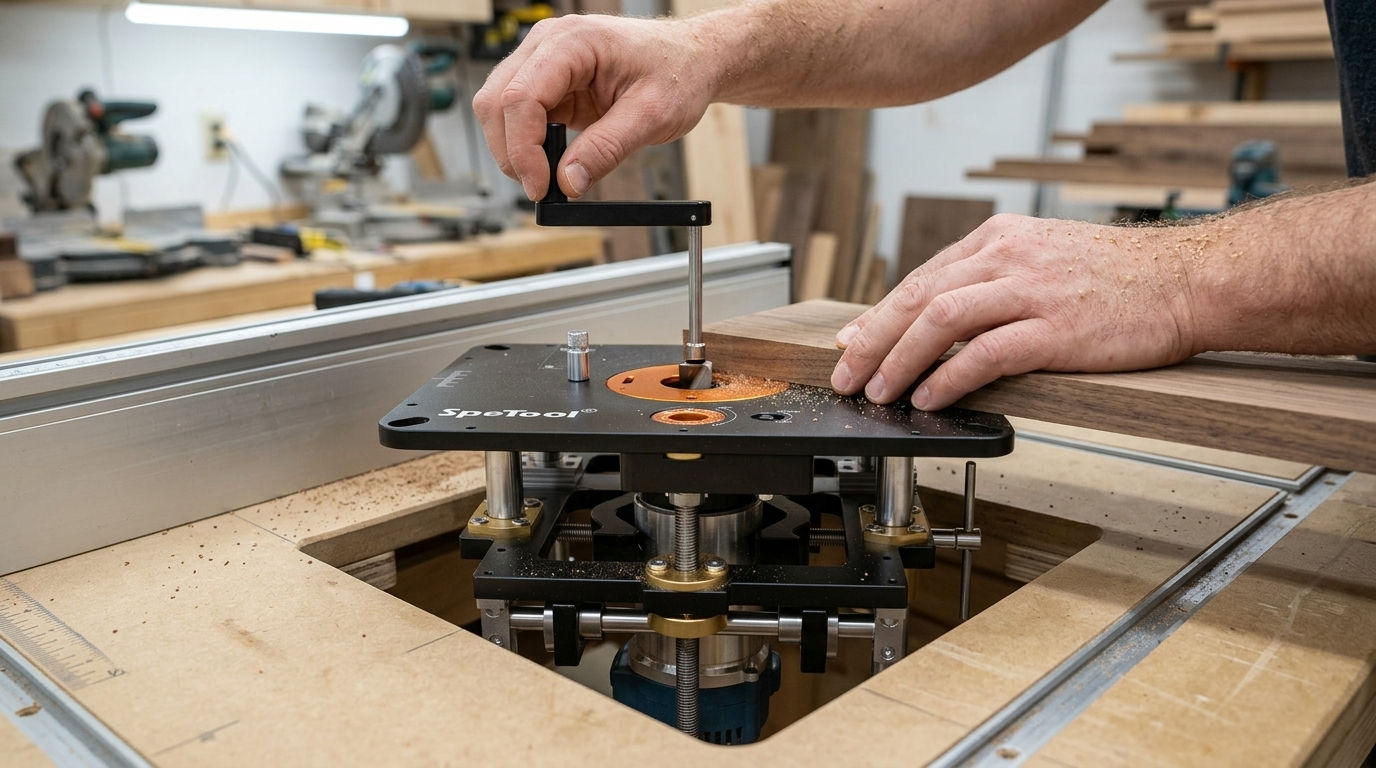
For those looking to upgrade their production flow, the SpeTool S02002 2-IN-1 Professional Router Jig is a game-changer. This high-strength aluminum juice groove jig eliminates the need for disposable MDF frames. It features an automatic vertical function for quick starts without manual calibration and built-in dual metric/imperial scales for absolute precision.
Repeatability: The Production Woodworker’s Priority
In a production environment, time is money. MDF templates often require "one-off" fabrication for specific sizes, leading to a workshop cluttered with dusty, single-use frames. An adjustable aluminum juice groove router jig solves this by offering a variable work area—up to 18” X 18” square or a 20” radius circle. This versatility means you can switch from a small cheese board to a massive brisket board in seconds, all while maintaining the high precision cutting required by professional standards.
Technical Comparison: Stability and Accuracy
Why does 15mm thick aluminum outperform 1/2-inch MDF? It comes down to contact area. Wider router guides on an aluminum jig router significantly increase the contact area with your router base, reducing the risk of tipping or "diving" during a cut. This stability minimizes material waste, which is crucial when working with expensive hardwoods like walnut or maple.
Conclusion
While MDF may suffice for a hobbyist making a single gift, the production-oriented professional needs tools that withstand the rigors of daily use. Investing in a durable aluminum juice groove jig like the SpeTool S02002 ensures that your workflow remains efficient, your cuts remain precise, and your workshop remains organized. No more piles of disposable frames—just one high-performance tool for every project.