
Working with Thin Stock: Understanding Track Saw Square Minimum Thickness
Table of Contents
- Introduction to Thin Stock Precision
- Why 9mm is the Industry Standard Baseline
- Precision Engineering: The SpeTool Track Saw Square Guide
- Techniques for Working with Sub-9mm Materials
- Compatibility and Setup
- Conclusion
Introduction to Thin Stock Precision
For woodworkers specializing in cabinetry, furniture making, or intricate veneer work, precision is non-negotiable. While a track saw offers incredible portability and straightness, achieving a perfect 90-degree crosscut requires a high-quality track saw square. However, a common hurdle many craftspeople face is the 'minimum thickness' requirement of these tools. Understanding why this limit exists—and how to work around it—is essential for flawless results.
Why 9mm is the Industry Standard Baseline
Most professional-grade guide rail accessories, including the guide rail square, are designed with a registration lip that hooks over the edge of your workpiece. This lip ensures that the square stays perfectly perpendicular to the material. For the clamping mechanism to engage securely without slipping or tilting, a certain amount of vertical surface area is required.
The 9mm (approximately 3/8 inch) threshold is the sweet spot for mechanical stability. Below this thickness, many squares lose their ability to 'bite' onto the edge effectively. Using a square on material thinner than 9mm without proper support can lead to slight angular deviations, defeating the purpose of using a precision guide.
Precision Engineering: The SpeTool Track Saw Square Guide
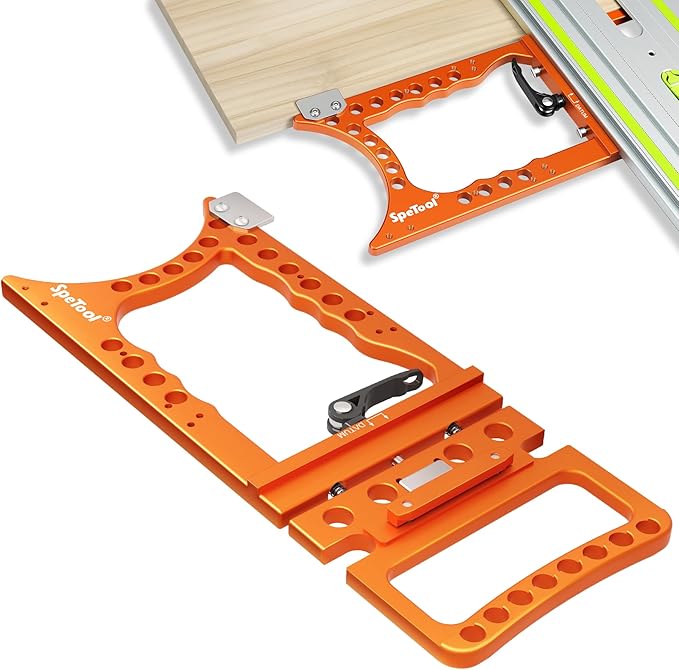
When your project demands the highest level of accuracy, the SpeTool 90-Degree Precision Track Saw Square is an industry-leading solution. This track saw square guide is engineered specifically for woodworking projects that require ultra-tight tolerances.
- [±0.01° Ultra-Precision 90°]: SpeTool achieves perfect 90° cuts every time with a guaranteed accuracy of ±0.01°, locking securely across the entire contact surface.
- [Quick & Effortless Operation]: It features a smooth, one-handed quick-lock mechanism for instant setup, significantly improving workflow efficiency.
- [Superior Stability]: Built with an extra-large and thicker design, it provides enhanced rigidity and reduced vibration compared to lighter alternatives.
- [Scratch-Free & Rail-Protect]: The clamping system securely grips your rail without leaving marks or dents, protecting your investment in expensive guide rails.
- [Wide Compatibility]: This tool is universally compatible with Festool, Makita, Milwaukee, Powertec, and Wen track saw guide rails.
NEED TO KNOW: While this tool offers best-in-class stability, the minimum workpiece thickness is 9MM. This design ensures that the ±0.01° precision is maintained throughout the cut by providing a rock-solid registration point.
Techniques for Working with Sub-9mm Materials
If you are working with 1/4" (6mm) plywood or thin veneers, you can still utilize a high-precision track saw square. The most common professional workaround is to use a 'sacrificial' or 'spacer' board. By placing a 9mm or thicker scrap piece underneath your thin stock, you provide the guide rail square with the necessary edge surface to lock onto securely.
Alternatively, many woodworkers create a dedicated cutting station or a 'MFT-style' table where the track is fixed, allowing the thin stock to be slid underneath. For more tips on shop-built jigs, check out resources at Wood Magazine or browse the SpeTool collection for complementary accessories.
Compatibility and Setup
One of the biggest advantages of modern precision squares is their versatility. Whether you are using a Festool or a Makita system, the clamping geometry must be exact. The SpeTool guide rail square is specifically tested to ensure it doesn't flex or shift during the locking process, which is a common complaint found in user reviews of cheaper alternatives. Proper setup involves ensuring your guide rail is clean and that the square is fully seated before engaging the quick-lock lever.
Conclusion
Understanding the minimum thickness requirement for your track saw square is the first step toward achieving professional-grade joinery. While 9mm is the baseline for tools like the SpeTool guide, being aware of this limitation allows you to adapt your workflow for thinner materials without sacrificing that ±0.01° accuracy. Invest in quality, protect your rails, and ensure every cut is perfectly square.