
Stop the Wobble: How a 3-Pole Drill Guide Provides Maximum Stability
Table of Contents
The Problem with Handheld Precision
For many woodworkers, the drill press is a sanctuary of precision. However, you can't always bring your project to the press. Whether you are working on a large tabletop, installed cabinetry, or site-specific construction, you are often forced to use a handheld drill. This is where the frustration begins. Standard handheld drilling often leads to 'wobble'—that slight deviation that turns a perpendicular hole into a slanted mess.
Finding an accurate handheld drilling jig is the difference between a professional finish and a ruined piece of expensive hardwood. While many portable guides exist on the market, most suffer from the same structural flaw: they lack the rigidity to counteract the torque of a modern electric drill. According to engineering principles of axial alignment, the more points of support a guide has, the less chance there is for radial runout.
The Engineering Gap: 2 Poles vs. 3 Poles
The industry standard for portable drill guides has long been the two-pole system. While lightweight, two poles allow for a 'see-saw' effect under pressure. If your hand isn't perfectly centered, the carriage can tilt slightly, leading to an oval-shaped hole.
This is where the 3-pole design changes the game. By adding a third vertical support, the jig creates a triangular footprint of stability. Triangles are the strongest shape in geometry, and in a drilling jig, they provide 360-degree resistance against lateral forces. This ensures that the SPE Tools Portable Drill Guide maintains its alignment even when high torque is applied by a powerful cordless drill.
Millimeter-Level Accuracy: The 0.004-Inch Standard
Accuracy is not just about the poles; it is about the tolerances of the components. A truly accurate handheld drilling jig must eliminate 'play' in the chuck. The SPE Tools model is constructed entirely from metal, featuring a heavy-duty drill chuck that achieves an average radial runout of 0.004 inch. This level of precision is virtually unheard of in portable tools, effectively giving you the portability of a handheld drill with the accuracy of a stationary drill press.
Friction-Free Operation with Linear Bearings
One common complaint in Amazon reviews for budget guides is that they 'stutter' or bind when sliding down the poles. If the movement isn't smooth, the user tends to push harder, which leads to inaccuracy.
To solve this, high-end guides utilize special liner ball bearings. This design significantly reduces friction, allowing for one smooth motion without stopping. Not only does this improve accuracy, but it also means you no longer need to constantly apply lubrication to the guide poles, keeping your wood projects clean from oil stains. For more advanced techniques on maintaining drill accuracy, check out the resources at Fine Woodworking.
Angles, Cylinders, and Stability
Woodworking isn't always about 90-degree holes. Whether you're building a chair with splayed legs or a custom staircase, angle control is vital. A professional-grade jig should offer:
- 0-60° Angle Adjustability: The ability to set infinite angles with double locks every 7.5° ensures the jig doesn't slip mid-drill.
- Heavy-Duty All-Aluminum Base: At 8.36lb, the base provides a rock-solid foundation that won't skip across the wood surface.
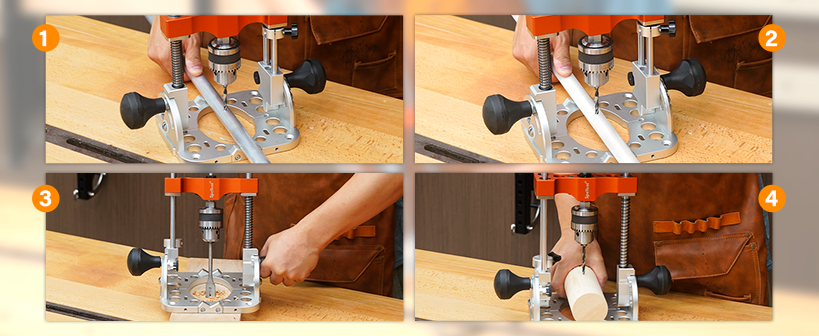
- V-Block Integration: This allows the user to center holes on cylindrical work-pieces like dowels or pipes effortlessly.
- Dual Removable Center Pins: These enable you to create perfectly centered holes without constant readjustment.
If you are serious about upgrading your workshop, explore the full range of professional accessories at SPE Tools.
Conclusion
Stopping the wobble isn't just about a steady hand; it's about better engineering. By moving from a standard 2-pole system to a robust 3-pole accurate handheld drilling jig, you eliminate the mechanical failures that cause inaccuracy. With 0.004-inch precision and a heavy 8.36lb aluminum base, the SPE Tools Portable Drill Guide ensures that your holes are straight, your angles are true, and your projects are professional.