
Achieving 0.004 Inch Precision: Can a Hand Drill Really Match a Milling Machine?
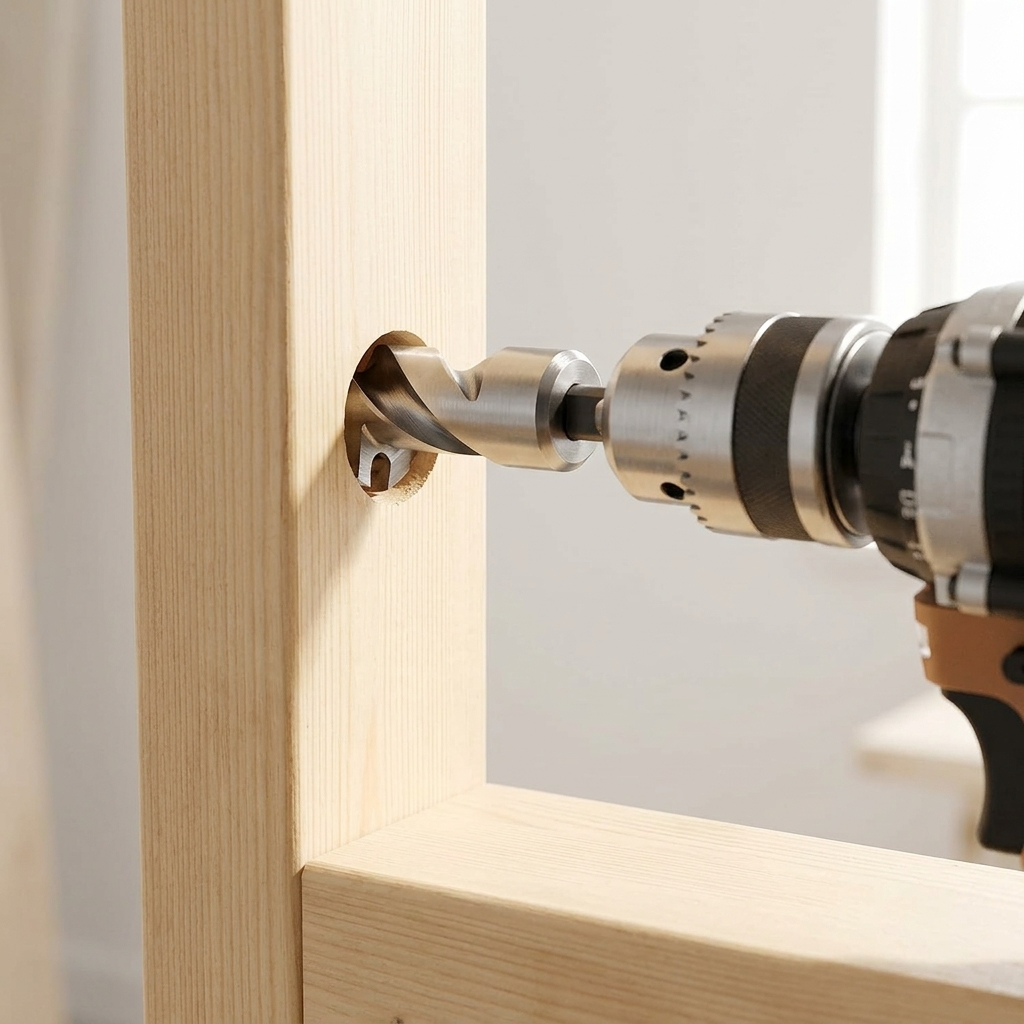
For precision-oriented makers and technical hobbyists, the 'wobble' or 'slop' of a standard handheld drill is the ultimate enemy. When you need a hole perfectly perpendicular or at a precise 45-degree angle, a handheld drill usually falls short, and a stationary drill press isn't always portable enough for the job. This is where the engineering of a high-end drill guide for hand drill precision changes the game.
By incorporating industrial-grade components, modern guides are pushing the boundaries of what manual tools can achieve, targeting a radial runout of just 0.004 inches—a specification usually reserved for milling machines.
Table of Contents
- The Engineering of 0.004 Inch Precision
- Eliminating 'Slop' with Linear Ball Bearings
- The Triple-Pole Stability Factor
- Angle Adjustability and the All-Aluminum Base
- Conclusion: Is It Worth It?
The Engineering of 0.004 Inch Precision
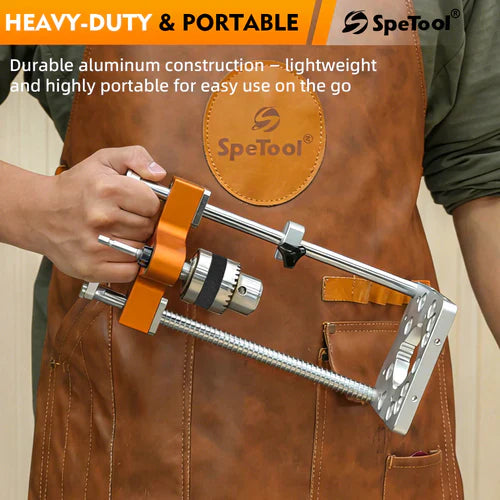
In the world of machining, radial runout is the measure of how much a rotating tool deviates from its center. Most consumer-grade drill guides have noticeable play, leading to oversized holes and broken bits. However, the SPEtools Portable Drill Guide is constructed entirely from metal, featuring a heavy-duty chuck that achieves millimetre-level precision. With an average radial runout of 0.004 inch, it bridges the gap between the portability of a handheld drill and the rigid accuracy of a drill press.
Eliminating 'Slop' with Linear Ball Bearings
The primary reason most drill guides feel 'sticky' or 'loose' is the use of simple bushings. To solve this, high-performance models adopt a special liner ball bearing design. These bearings reduce friction significantly, allowing for a smoother operation without the need for constant lubrication. For woodworking enthusiasts, this means you can drill in one fluid motion, eliminating the 'chatter' marks that occur when a drill bit binds or vibrates.
The Triple-Pole Stability Factor
While most guides use two guide poles, the most stable drill guide for hand drill precision utilizes a three-pole system. These three guide poles are essential for absorbing the impact force and high torque of modern electric drills. This design prevents the guide from flexing under pressure, ensuring that the hole you start is the hole you finish, without any internal damage to the workpiece. This stability is further enhanced by an assisted spring that provides balanced counter-pressure during the descent.
Angle Adjustability and the All-Aluminum Base
Precision isn't just about 90-degree holes. The ability to hit a specific angle repeatedly is what separates a hobbyist tool from a professional one. High-end guides offer:
- 0-60° Angle Adjustment: Infinite adjustment capabilities for complex joinery.
- Positive Stops: Double locks every 7.5° to ensure the angle won't shift mid-operation.
- Built-in V-Block: Essential for centering holes on cylindrical stock like pipes or dowels.
The 8.36lb all-aluminum base is hard-anodized for durability, providing a rock-solid foundation that doesn't slide. Dual removable center pins allow you to find the center of your material instantly, a feature frequently praised in Amazon reviews by users who previously struggled with manual layout errors.
Conclusion: Is It Worth It?
If your projects require the accuracy of a machine shop but your workspace (or budget) doesn't allow for a full-sized mill, a precision-engineered drill guide is the solution. By focusing on metal construction and linear bearing technology, tools like the SPEtools Drill Guide offer a level of control that was previously impossible for handheld tools. It’s an investment in accuracy that pays for itself in saved materials and professional-grade results.