
Table of Contents
- The Challenge of Steep Angle Woodworking
- Achieving 0.004 Inch Precision at 60 Degrees
- The Mechanics: 0-60° Scale and 7.5° Double Locks
- Stability with 3 Guide Poles and All-Aluminum Base
- Step-by-Step: Drilling Your 60 Degree Hole
- Drilling Cylindrical Workpieces
The Challenge of Steep Angle Woodworking
For designers and artistic woodworkers, the ability to drill extreme angles is often the difference between a mundane project and a masterpiece. While standard projects often rely on 90 or 45-degree angles, drilling 60 degree holes in wood presents a unique set of challenges. At such a steep lean, drill bits tend to 'walk' or skid across the surface, and maintaining consistent depth becomes nearly impossible with a standard handheld drill.
To solve this, many turn to a diagonal drill guide. However, most consumer-grade guides only offer adjustments up to 45 degrees. To truly master the lean, you need a specialized portable drill guide for hand drill that supports a wider range of motion without sacrificing stability.
Achieving 0.004 Inch Precision at 60 Degrees
Precision is paramount when creating complex joints or decorative features. The SpeTool Portable Drill Guide is engineered to deliver millimetre-level accuracy. Constructed entirely from metal, its heavy-duty drill chuck achieves an average radial runout of just 0.004 inch. This level of metal drill guide precision is typically reserved for stationary industrial drill presses, but is now available in a portable format.
The Mechanics: 0-60° Scale and 7.5° Double Locks
One of the standout features of this drill guide angle system is its flexibility. While most tools limit your creativity, the SpeTool guide allows for infinite adjustments between 0° and 60°. For designers requiring repeatable accuracy, the tool features double locks that engage every 7.5 degrees. This ensures that once you set your angle, it stays locked, preventing the 'angle creep' that often ruins high-end wood projects.
Whether you are building a mid-century modern chair with splayed legs or an intricate sculptural piece, the 7.5-degree increments provide a reliable reference point for symmetrical drilling.
Stability with 3 Guide Poles and All-Aluminum Base
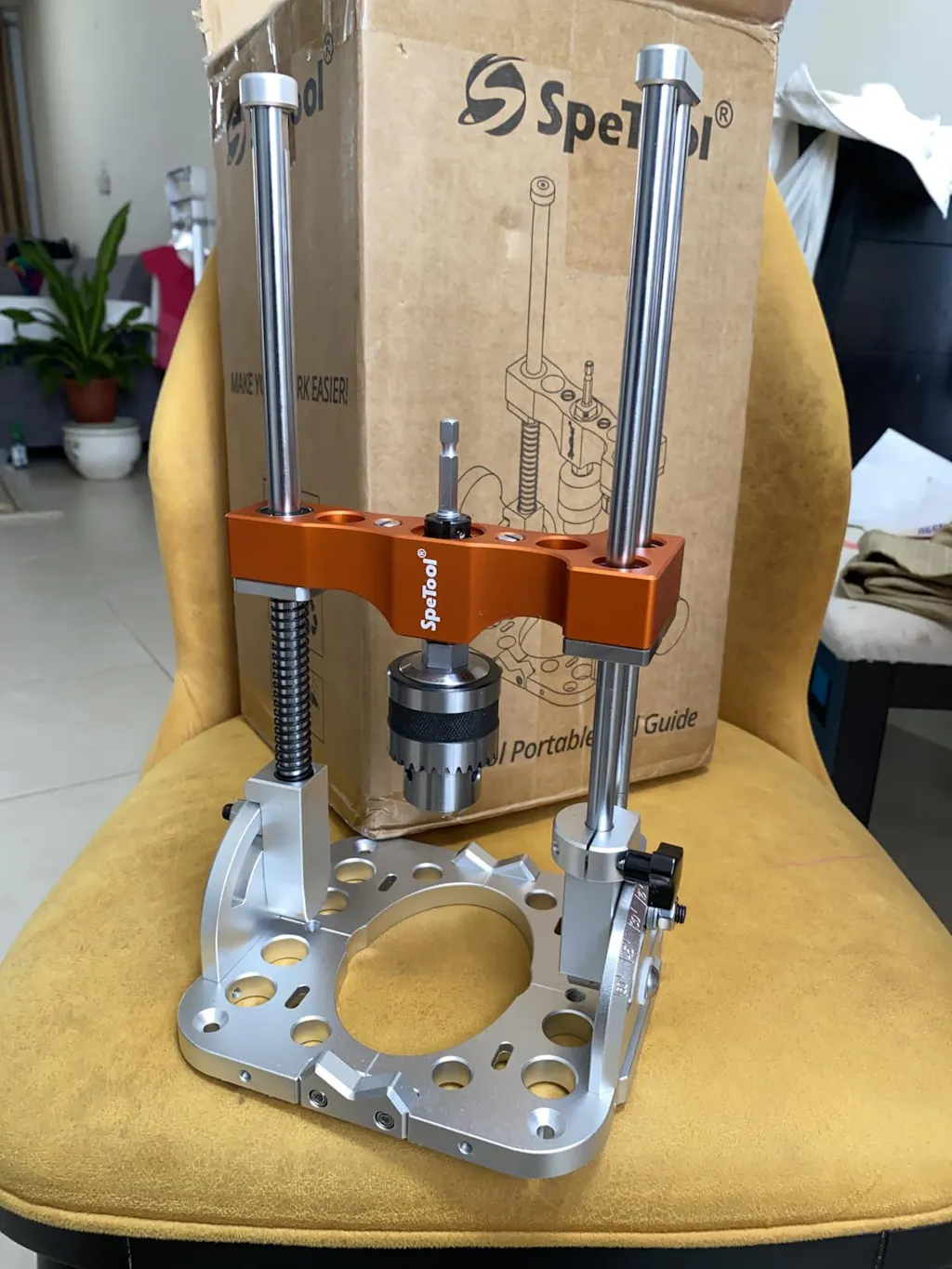
Steep angles put significant lateral pressure on your tools. A standard mini drill guide with only two poles often flexes under this stress. The SpeTool plunge drill guide utilizes three guide poles to distribute force evenly. This design prevents damage to the hole walls caused by the impact force of the electric drill.
The foundation of this stability is the all-aluminum base. Weighing in at 8.36lb and finished with hard anodizing, the base provides a rock-solid platform. According to drill press mechanics, mass and rigidity are the primary enemies of vibration, and this heavy-duty base delivers both.
Step-by-Step: Drilling Your 60 Degree Hole
- Mark Your Center: Use a center punch to create a starting point for your bit.
- Set the Angle: Loosen the adjustment knobs and align the pointer to 60° on the scale. Utilize the 7.5° double locks for maximum stability.
- Secure the Base: Use the dual removable center pins to align the guide with your mark. If necessary, clamp the base to your workpiece.
- The Plunge: Thanks to the special liner ball bearings, you can perform a smooth plunge without the need for constant lubrication. The assisted spring will help you maintain control as you exit the hole.
Drilling Cylindrical Workpieces
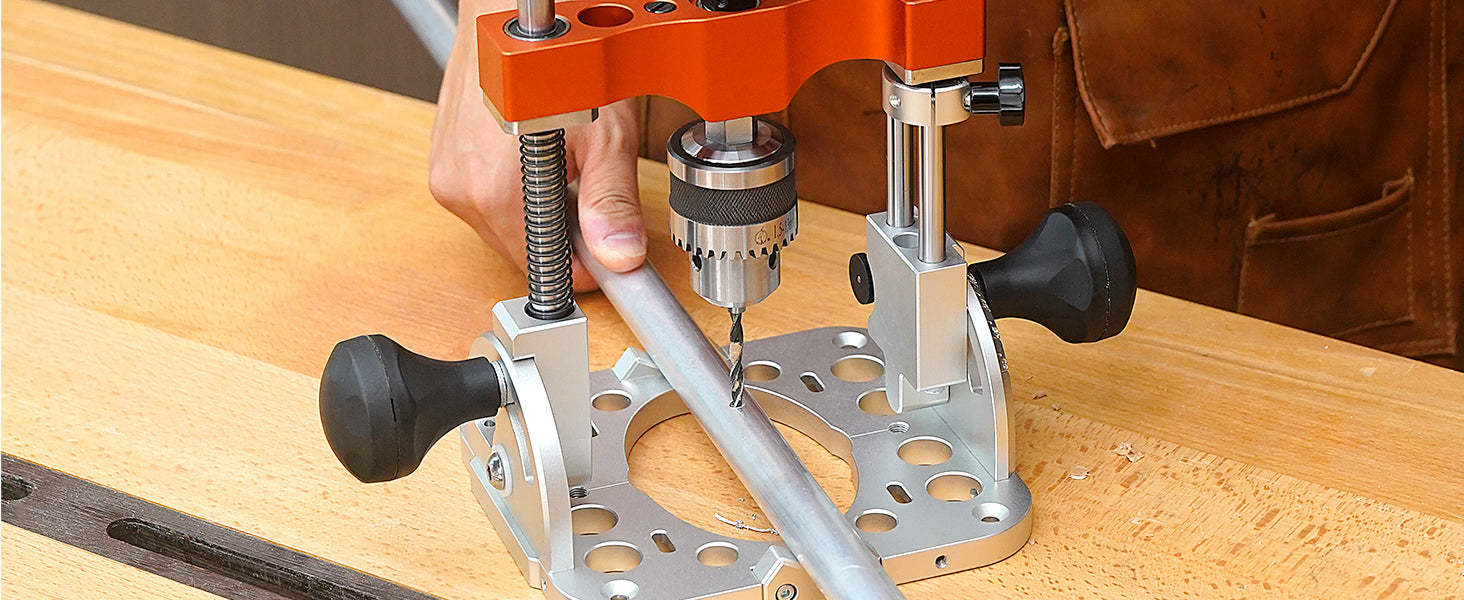
Artistic woodworking often involves round stock, such as dowels or tree branches. Drilling a 60-degree hole into a cylinder is notoriously difficult. This portable drill guide features a built-in V-block in the base, allowing it to sit securely on cylindrical work-pieces. This versatility makes it an essential tool for those looking to explore non-traditional woodworking forms. For more specialized bits to use with your guide, check out our collection of woodworking accessories.