
What is Parallelogram Action? The Secret to Perfectly Flat Table Tops
Every woodworker knows the frustration of a glue-up gone wrong. You spend hours jointing boards and dry-fitting, only to find that once the pressure is applied, your panel begins to cup or bow. Traditional bar clamps apply pressure from the sides, but they do nothing to keep the boards flush against each other. This is where panel clamps equipped with parallelogram action change the game.
Table of Contents
- What is Parallelogram Action?
- The Problem with Standard Clamps
- Why Choose the SpeTool Panel Clamp?
- Technical Specifications and Versatility
- Pro-Tips for Success
What is Parallelogram Action?
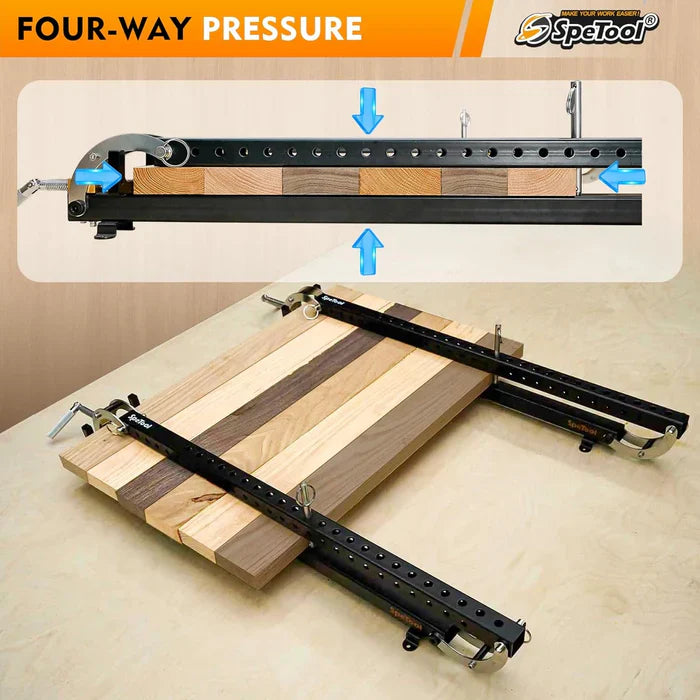
In mechanical engineering, a parallelogram linkage allows for the movement of parts while keeping them parallel to their original orientation. In the context of woodworking, parallelogram action panel clamps use this geometry to apply pressure in four directions simultaneously.
When you tighten the handle of a spetool clamp, the parallelogram couplers shift. This motion forces the clamping bars inward (to close the glue joint) and downward/upward (to keep the boards perfectly flat). Instead of just squeezing the edges, the clamp acts as a built-in caul, ensuring that your table top remains flush without the need for additional weights or complicated jigs.
The Problem with Standard Clamps
Standard pipe or bar clamps apply linear force. If your boards aren't perfectly square or if you apply too much pressure, the panel will naturally want to "tent" or buckle in the middle. Woodworkers often try to solve this with cauls—sacrificial pieces of wood clamped across the face—but this adds complexity and time to an already stressful glue-up window.
By using a spetool panel clamp, you eliminate the need for cauls. The unique 4-way pressure mechanism ensures that even wide panels stay flat under heavy clamping force.
Why Choose the SpeTool Panel Clamp?
The SpeTool 4-Way Panel Clamp 2-Pack is designed specifically to solve the "bowing" problem. Here is what makes it a standout tool for professionals:
- Simultaneous 4-Way Pressure: With parallelogram couplers, these clamps apply pressure from all sides at once. This makes achieving flush joints significantly easier than using traditional methods.
- Durable Construction: Made from high-quality steel pipe with a durable powder-coat finish, these clamps are built to last. The inclusion of copper thread bushings ensures that the retaining pins remain strong and reliable over years of use.
- Easy Glue Cleanup: Glue squeeze-out is inevitable. However, the special surface treatment on the spetool clamp allows dried glue to be easily removed by hand or a putty knife without damaging the fixture.
- Ease of Use: The parallelogram-action couplers and fix pins allow for rapid adjustment of width and thickness, allowing you to focus on the alignment of your wood rather than struggling with your tools.
Technical Specifications and Versatility
Whether you are building a delicate cutting board or a massive workbench, versatility is key. The spetool panel clamp is designed to accommodate a wide range of project sizes:
- Width Capacity: Up to 24 inches wide.
- Thickness Range: Accommodates panels from 1/4" up to 3" thick.
- Ideal Projects: Perfect for table tops, wide door panels, cabinet tops, and thick bench tops.
For more information on optimizing your workshop layout, check out our guide on precision woodworking tools.
Pro-Tips for Success
While the parallelogram action panel clamps are intuitive, there is a slight learning curve. To get the best results:
- Follow the Manual: As noted in user feedback, it is essential to follow the instructions or video guides for the initial setup to ensure the couplers are oriented correctly.
- Check Your Stock: Even the best panel clamps work better when your stock is properly jointed. Ensure your edges are 90 degrees before glue-up.
- Even Spacing: Space your clamps every 8-12 inches for maximum flat pressure across long table tops.