You’ve marked the spot, pulled the trigger, and… the bit walked. Again. You’ve looked at dozens of drill guides ranging from $15 to $150, but reviews say one wobbles, another has a tiny base, and a third wears out after a few uses. So which one actually works?
In this drill guide comparison, I’ll put five popular portable drill guides head‑to‑head—looking at accuracy, stability, angle range, and real value. Whether you’re a weekend woodworker or a pro, by the end you’ll know exactly which model belongs on your bench.
Table of Contents
-
Why You Need a Drill Guide
-
How We Compare: The 6 Key Metrics
-
Five Drill Guides Compared
-
Product A: Entry‑level Plastic Guide Block
-
Product B: Budget Two‑Post Drill Jig
-
Product C: SpeTool S04001 Three‑Post Linear Rail Guide
-
Product D: Magnetic Base Drill Stand
-
Product E: Premium Portable Drill Press Attachment
-
-
Comparison Table: Accuracy, Angle, Stability, Price
-
Which Drill Guide for Your Job?
-
Common Myths About Drill Guides
-
Verdict: The Best Portable Drill Guide
1. Why You Need a Drill Guide
A hand drill is convenient, but it has one big weakness: it’s very hard to keep perfectly perpendicular by hand. A slight tilt and your hole is off. On a curved surface, the bit skates. When drilling hinge holes, a 1mm error means the door won’t close right.
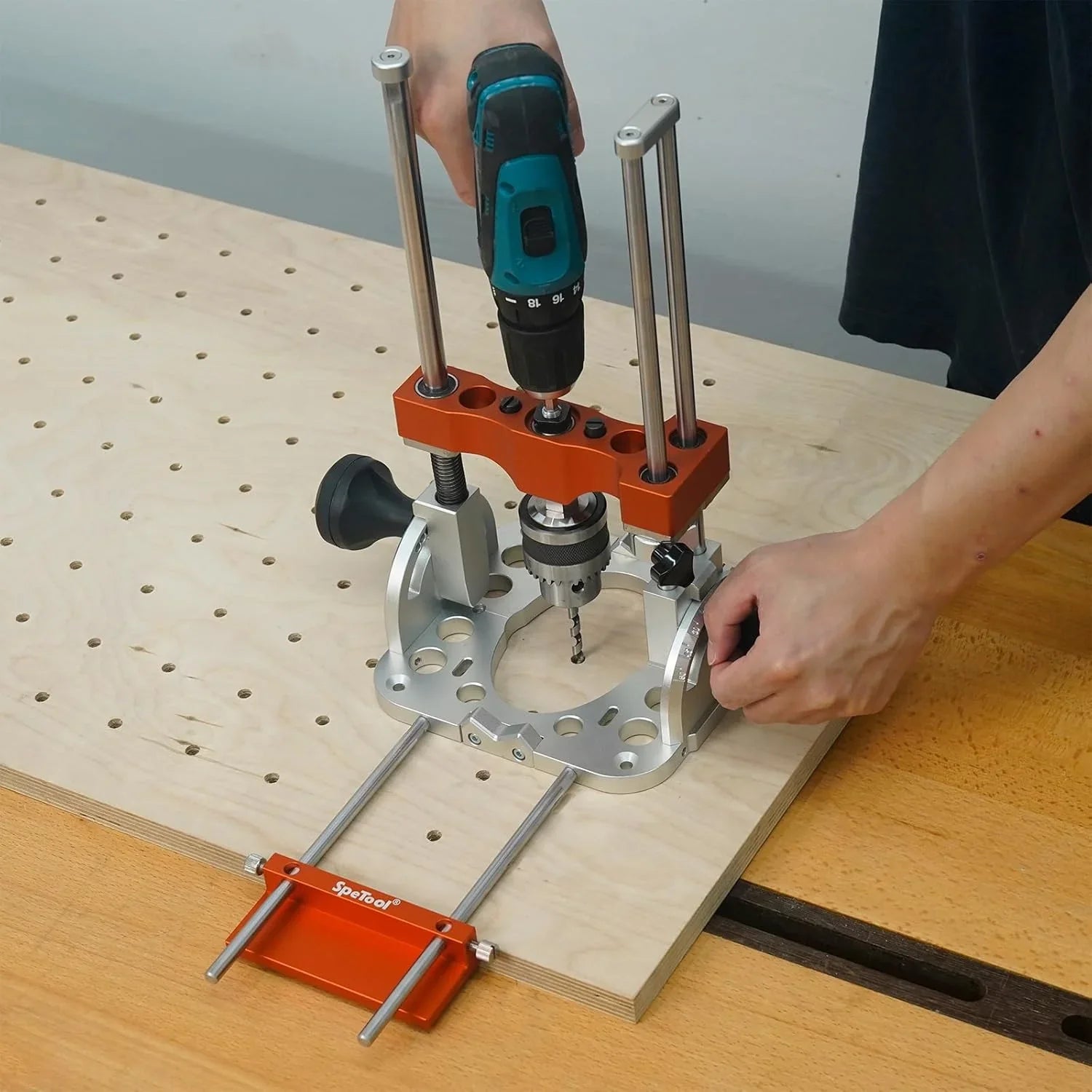
A good portable drill guide turns your hand drill into something close to a drill press. Using guide rods, linear bearings and a heavy base, it forces the bit to move only in the intended direction. You don’t need a steady hand—you need a good guide.
That’s why more and more people are doing a proper drill guide comparison before buying.
2. How We Compare: The 6 Key Metrics
Here are the 6 things that actually matter:
| Metric | What It Means |
|---|---|
| Runout | How much the bit wobbles. Lower is better. Ideal ≤ 0.005″ |
| Base stability | Material (plastic / aluminum / steel), weight, V‑groove for round stock |
| Angle adjustment | Can it drill angled holes? Range? Locking mechanism? |
| Guide system | Single‑post, two‑post, three‑post? Linear bearings? |
| Chuck compatibility | Fits most drills? (Usually 1/2″ or 13mm) |
| Price & warranty | Value, not just cost. Return policy matters |
Now let’s compare.
3. Five Drill Guides Compared
Product A: Entry‑level Plastic Guide Block
-
Price: $10–20
-
Pros: Very cheap, ultra‑light, pocketable
-
Cons: Tiny base, no angle adjustment, plastic wears out fast (holes become oval), large slop between bit and guide hole
-
Best for: Occasional DIY, a few straight holes, zero precision requirement
Real user says:
“It was cheap, but after 50 holes it’s useless. I should have bought a real drill guide.”
Product B: Budget Two‑Post Drill Jig
-
Price: $30–50
-
Pros: Much more stable than plastic, basic depth stop, decent value
-
Cons: Noticeable play between rods and sleeves, thin base bends under pressure, angle adjustment usually 0–45° only and locks poorly, light weight → lifts when drilling fast
-
Best for: Light woodworking, tight budget, moderate accuracy
Real user says:
“Better than the plastic block, but the chuck still wobbles when drilling deep holes. You get what you pay for.”
Product C: SpeTool S04001 Three‑Post Linear Rail Drill Guide
-
Price: Mid‑high range (approx $80–100)
-
Strengths:
-
Three linear‑bearing guide rods → near‑zero play, smooth and rigid motion, runout ≈ 0.004″
-
0–60° angle adjustment with positive 7.5° locks → stable angled holes
-
8.36 lb aluminum base with V‑groove → holds flat stock and pipes securely
-
1/2″ chuck compatible with most hand drills
-
-
Best for: Users who’ve tried 5–6 cheap guides and are done settling; woodworkers who demand real accuracy
Real user says:
“After half a dozen disappointing drill guides, SpeTool finally lets me stop settling. Zero play, accurate even at 45°—this is how a tool should work.”
Product D: Magnetic Base Drill Stand
-
Price: $150+
-
Pros: Strong magnet locks onto steel surfaces, extremely stable for metalworking
-
Cons: Useless on wood or plastic; heavy; no angle adjustment (usually 90° only); expensive
-
Best for: Professional metalworkers, steel fabrication shops
Real user says:
“Rock solid on I‑beams, but I can’t use it on my woodworking bench.”
Product E: Premium Portable Drill Press Attachment
-
Price: $100–200
-
Pros: Almost a mini drill press; some models have their own motor
-
Cons: Bulky, heavy, defeats “portable” purpose; expensive for what it offers
-
Best for: Fixed workbench, large budget, portability not needed
Real user says:
“It works, but it’s too big. I switched back to a compact drill guide.”
4. Comparison Table: Accuracy, Angle, Stability, Price
| Product | Runout (inch) | Angle range | Base material / weight | Guide system | Rating |
|---|---|---|---|---|---|
| Plastic block | >0.020 | 90° only | Plastic / <1 lb | None | ⭐⭐ |
| Two‑post jig | 0.010–0.020 | 0–45° | Aluminum / 2–3 lb | Two‑post (plain sleeve) | ⭐⭐⭐ |
| SpeTool S04001 | ≈0.004 | 0–60° | Aluminum / 8.36 lb | Three‑post + linear bearings | ⭐⭐⭐⭐⭐ |
| Magnetic stand | ≈0.005 | 90° only | Cast steel / >10 lb | Single‑post | ⭐⭐⭐⭐ (metal only) |
| Premium drill press attachment | 0.003–0.005 | 0–45° | Mixed / 5–8 lb | Two‑post | ⭐⭐⭐ |
5. Which Drill Guide for Your Job?
Cabinet making / hinge installation
You need perpendicular accuracy and repeatability.
-
Recommend: SpeTool S04001 or two‑post jig
-
Why: SpeTool’s three linear rails eliminate wobble; heavy base won’t lift.
Metal drilling / round stock
Metal requires rigidity. Round stock needs a V‑groove.
-
Recommend: Magnetic base (steel only) or SpeTool S04001
-
Why: SpeTool’s base has a V‑groove and enough mass; magnetic base is great for steel but useless on other materials.
Angled drilling (0–60°)
Many guides only go to 45°. For pocket holes, angled dowels or compound joinery, 60° matters.
-
Top pick: SpeTool S04001 (or premium 60° models)
-
Why: Locks every 7.5° and maintains the drilling point even when tilted.
Tight budget / occasional use
If you drill only a few dozen holes a year.
-
Recommend: Plastic block or two‑post jig
-
Warning: Cheap tools often cost more in the long run. Many users say “I wish I’d bought the good one first.”
6. Common Myths About Drill Guides
Myth 1: “All drill guides are the same – just a block with holes.”
Truth: Guide rod clearance, base weight and linear bearings make a night‑and‑day difference.
Myth 2: “A plastic block is good enough.”
Truth: Plastic wears quickly. After 50–100 holes the guide hole becomes oval, and your holes go crooked.
Myth 3: “I’ll never need angle adjustment.”
Truth: When you do pocket holes, angled joinery or tilted drilling, a fixed 90° guide is frustrating.
Myth 4: “Cheaper saves money.”
Truth: A wrong tool wastes your materials and time. Buying a decent tool once is cheaper than buying twice.
7. Verdict: The Best Portable Drill Guide
If you drill a few holes a year and are on a tight budget, a two‑post jig will work. But if you’ve already tried five or six drill guides and you’re tired of wobbling bases, loose chucks, and crooked holes—stop settling.
The SpeTool S04001 three‑post linear rail drill guide is the closest you can get to a drill press in a portable package.
-
It’s not cheap, but it puts the hole exactly where you aim.
-
Three linear‑bearing rods deliver near‑zero runout (≈0.004″).
-
0–60° angle adjustment with positive locks covers almost every woodworking joint.
-
The 8.36 lb aluminum base stays planted like it’s welded to your bench.
Try it: 90‑day hassle‑free returns + 365‑day warranty. The only thing you’ll lose is the frustration of crooked holes.
FAQ
Q: Will a drill guide work with any hand drill?
A: Most accept 1/2″ (13mm) chucks, which covers the vast majority of drills on the market.
Q: Is 0.004″ runout noticeable in real use?
A: Absolutely. When drilling deep or angled holes, cheaper guides amplify wobble; SpeTool stays tight.
Q: What’s the return/warranty policy?
A: SpeTool offers 365‑day warranty and 90‑day free returns. You can test it risk‑free.